What Researchers Get Wrong About Citation Checkers (And What We Learned Building One)
At some point during manuscript preparation, most researchers do the same thing: run their references through a citation checker, see a mostly green report, and move on with reasonable confidence.
That confidence is often warranted. But sometimes it is not, and the gap between those two outcomes has less to do with the tool finding errors and more to do with what the tool is actually checking, and what it chooses to hide.
The Black Box Problem
Most citation checkers work like airport security scanners. Something goes in, a result comes out, and you are expected to trust the process without seeing it.
This works fine when the result is right. The problem surfaces when it is wrong, or incomplete, and you have no way of knowing. A reference gets flagged as unverifiable. Is the source obscure? Was there a formatting issue in the author name? Did the tool simply fail to find it? The tool does not say. You either trust the verdict or you do not.
Researchers have quietly accepted this as normal. But it means they are making real decisions, about whether to reformat a citation, whether a source is legitimate, whether a flag deserves follow-up, with no visibility into the reasoning behind the result.
When we were building CiteOrbit, this was one of the first things we wanted to change. Every database search we run produces results that are stored and accessible. The default report stays clean and readable, but if something looks off, researchers can click through and see exactly what the tool found, which candidate matches came back, what matched and what did not. The verdict is no longer something you accept on faith. The evidence is one click away.
That distinction turns out to matter more than it sounds.
Why Accessible Evidence Changes the Picture
When the underlying search results are reachable, two things happen that cannot happen in a black box system.
First, researchers can catch errors the tool itself would miss. A source that matches on title but carries a wrong publication year is technically a match. A researcher who clicks through spots the discrepancy in seconds. Hidden behind a green status icon, it passes unnoticed.
Second, those search results become a signal for something most tools never surface: AI-generated references.
This has become a genuine problem. Language models hallucinate citations that look entirely plausible. Realistic author names, believable journal titles, credible publication years. The source simply does not exist, and a metadata check against a non-existent source returns nothing useful.
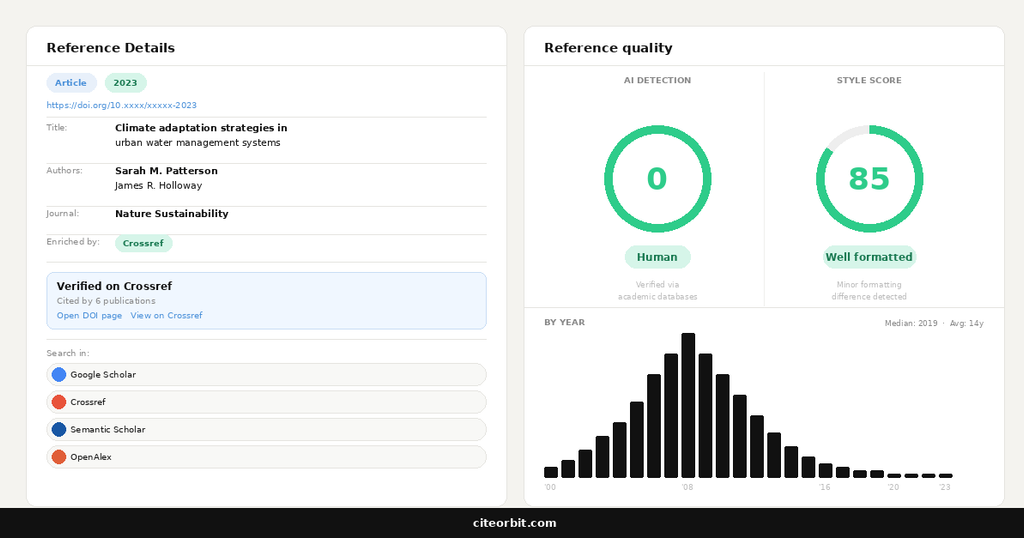
Other tools report this as "unverified" and stop there. Based on the pattern of search results, or the absence of any, CiteOrbit assigns an AI generation likelihood score and shows it explicitly in the report. Researchers working with AI-assisted drafts, or anyone reviewing a manuscript that may have used AI tools, can see where the hallucination risk is concentrated rather than discovering it later. No other tool we are aware of makes this metric visible to the user.
What the Reference List Is Actually Telling You
Here is a question most citation tools never think to ask: what does this reference list say about the research itself?
A reference list is not just a compliance document. It is a record of the intellectual foundation behind a paper. How recent are the sources? How diverse are the publication types? How heavily does the paper draw on the authors' own prior work? Which sources appear once in passing, and which are cited repeatedly throughout the manuscript as load-bearing evidence?
These questions matter to researchers who want to understand whether their literature review is genuinely current and well-rounded. They matter even more to journal editors and peer reviewers evaluating whether a manuscript reflects serious, thorough engagement with the field. A paper drawing almost entirely from decade-old sources, or leaning heavily on a narrow cluster of journals, or inflating its reference count with self-citations, tells a story that a standard verification report never captures.
CiteOrbit produces an editorial output alongside the technical verification: publication year distribution, source type breakdown, self-citation rate, how frequently each source is cited across the manuscript. This reframes the reference list from a checklist item into a diagnostic, a way of reading how deep and how honest the research engagement actually is. We have not seen another tool approach references this way.
For editors and reviewers, this layer is particularly valuable at the screening stage. A quick look at the editorial profile can flag manuscripts worth a closer look before the formal review process even begins.
What Good Citation Checking Actually Looks Like
The gap in most citation tools is not technical capability. The databases exist. The matching algorithms work reasonably well. The gap is in what gets shared with researchers and what questions get asked about the output.
A tool that hides its search results is asking you to trust a verdict without evidence. A tool that stops at "verified" or "not found" is answering a narrower question than the one you actually need answered. And a tool that never reads the reference list as a whole is leaving the most useful part of the analysis untouched.
Researchers who understand this use verification tools differently: as a source of evidence to reason from, not a score to accept. The tool does the retrieval work. The researcher brings the judgment. That combination catches more than either one alone.
CiteOrbit was built to give researchers both a clean report and the ability to dig deeper whenever they need to, from database match evidence to the editorial story their reference list tells. Try it on your next manuscript.