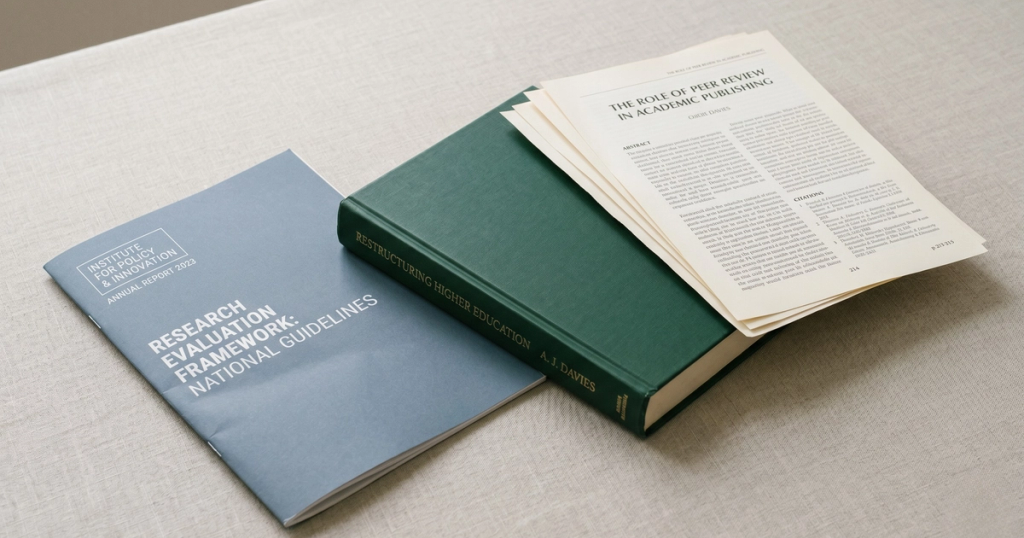
Not All Citations Are Created Equal: The Case for a Balanced Reference List
A well-built reference list tells a story. Look closely at the citations behind any rigorous piece of research, and you will find more than a stack of journal articles. You will find books that anchor the theory, peer-reviewed studies that validate the methodology, and government reports or working papers that ground the argument in real-world data. That mixture is not accidental. It reflects something fundamental about how knowledge is produced and communicated across disciplines.
Citation source diversity refers to the deliberate inclusion of multiple source types in a reference list: peer-reviewed journal articles, scholarly books and monographs, and grey literature such as government documents, institutional reports, and dissertations. Each category brings something the others cannot fully replicate.
Journal Articles: The Currency of Current Research
Journal articles are the standard unit of academic exchange for good reason. They undergo peer review, follow structured reporting formats, and are released at regular intervals, which makes them the fastest route from completed research to published record. For disciplines like medicine, biology, and the applied sciences, peer-reviewed articles are the primary vehicle for communicating new findings.
Their strength lies in specificity and recency. A 2024 randomised controlled trial published in a clinical journal carries an evidential weight that a book chapter written three years earlier simply cannot match on questions of current efficacy. For any research question where timing matters, journal articles do the heaviest lifting.
That said, journals are not without limitations. Word count restrictions mean that theoretical framing and contextual depth are often compressed or omitted altogether. And because journals have historically favoured studies with statistically significant positive results, the published record can skew toward confirmatory findings, a problem known as publication bias. [1]
Books and Monographs: Depth That Articles Cannot Afford
Where journal articles sprint, books take their time. Scholarly monographs provide the kind of sustained argumentation, theoretical synthesis, and methodological reflection that cannot be compressed into 7,000 words. [2] For humanities, history, social sciences, and many interdisciplinary fields, the monograph remains the primary unit of academic contribution. An analysis of the 2014 UK Research Excellence Framework found that monographs accounted for a substantial majority of outputs in arts and humanities disciplines, with some 8,500 monographs submitted to Panel D alone. [3]
Books carry a different intellectual function from articles. They are, as one publishing scholar put it, "an invitation to pause and reflect." [4] A researcher citing a book is usually drawing on a framework, a conceptual vocabulary, or a body of synthesised evidence that took years to assemble. Foundational theoretical works, for example, are almost always books: think of the sources most frequently cited in social science or philosophy. These seminal works are rarely journal articles. [2]
For citation purposes, books also serve as orientation points. When a reader encounters a reference to a monograph published by a university press, they understand that they are being pointed toward a comprehensive treatment of a topic, not a single study. That distinction carries real communicative value.
Grey Literature: Filling the Gaps Official Sources Leave Behind
Grey literature is material produced outside traditional commercial publishing channels. The term covers government reports, policy documents, dissertations, conference papers, working papers, clinical trial registries, NGO publications, preprints, and technical reports. [5] The Greynet International definition, established in Luxembourg in 1997 and expanded in New York in 2004, describes it as material "produced on all levels of government, academics, business and industry in print and electronic formats, but which is not controlled by commercial publishers." [5]
Three properties make grey literature genuinely valuable for researchers.
- Currency: Grey literature is released without the delays introduced by peer review cycles. A government health agency's epidemiological bulletin from last month contains data that no journal article can yet carry. [1]
- Completeness: Because journals preferentially publish positive results, a literature review built exclusively on journal articles will systematically underrepresent null findings, inconclusive data, and studies that failed to attract editorial interest. Including grey literature helps counteract this bias and produces a more honest picture of the evidence landscape. [1]
- Breadth of perspective: Academic publishing has historically reflected a narrow demographic and institutional base. Grey literature, produced by a far wider range of organisations and authors, brings in voices and viewpoints that peer-reviewed channels often miss. [6]
The challenge with grey literature is quality appraisal. Without standard peer review, evaluating the rigour of a report requires additional scrutiny: Who produced it? What was the funding source? Is the methodology described clearly? These questions take time to answer, which is part of why some researchers default to journal-only searches. But the cost of that shortcut, in terms of incomplete evidence, is often higher than the effort saved. [7]
Why the Balance Matters
A reference list drawing exclusively from any single source type carries risks. A citation profile built only on journal articles may be methodologically current but theoretically thin. One built only on books may be conceptually rich but empirically dated. One that incorporates grey literature without scholarly grounding can lack the rigour reviewers expect.
The right balance is discipline-dependent. In systematic reviews, including grey literature is considered essential to capture the full evidence base. [1] In historical scholarship, monographs often outnumber articles. [8] In fast-moving clinical fields, recent journal publications take precedence. Understanding which source type serves which purpose is a core research literacy skill.
This is also where citation analysis tools become practically useful. Seeing a breakdown of your own reference list by source type makes invisible habits visible. Are you over-relying on a small cluster of journals? Have you cited no grey literature in a policy-facing paper? Are your books all published more than a decade ago? These patterns are hard to notice when working source by source but become obvious when viewed in aggregate.
Putting It Into Practice
CiteOrbit's source type breakdown feature helps researchers do exactly this. By categorising your references across journals, books, and grey literature, it gives you a clear picture of whether your citation profile matches the evidential demands of your research question. Whether you are checking a dissertation bibliography, preparing a systematic review, or reviewing a manuscript before submission, understanding your source mix is a practical step toward more rigorous, well-rounded scholarship.
Start analysing your citation profile today at CiteOrbit.
References
[1] Paez A. Gray literature: An important resource in systematic reviews. J Evid Based Med. 2017;10(3):233–40.
[2] Proof-Reading-Service.com. The many benefits of writing an academic or scientific book [Internet]. 2025 [cited 2026 Jun 4]. Available from: https://www.proof-reading-service.com/blogs/academic-publishing/the-many-benefits-of-writing-an-academic-or-scientific-book
[3] Tanner S. An analysis of the arts and humanities submitted research outputs to the REF 2014 with a focus on academic books. London: King's College London, Academic Book of the Future project; 2016.
[4] MDPI Books. What is a monograph? Definition, importance, and how to write one [Internet]. 2026 [cited 2026 Jun 4]. Available from: https://www.mdpi.com/books/blog/post/monograph
[5] Schöpfel J, Farace DJ. Grey literature. In: Bates MJ, Maack MN, editors. Encyclopedia of Library and Information Sciences. 3rd ed. London: CRC Press; 2010. p. 2029–39.
[6] University of Illinois at Urbana-Champaign Library. Why use grey literature? [Internet]. [cited 2026 Jun 4]. Available from: https://guides.library.illinois.edu/c.php?g=1310347&p=9667363
[7] Adams J, Hillier-Brown FC, Moore HJ, Lake AA, Araujo-Soares V, White M, et al. Searching and synthesising 'grey literature' and 'grey information' in public health: critical reflections on three case studies. Syst Rev. 2016;5(1):164.
[8] Dalton MS, Charnigo L. Historians and their information sources. Coll Res Libr. 2004;65(5):400–25.