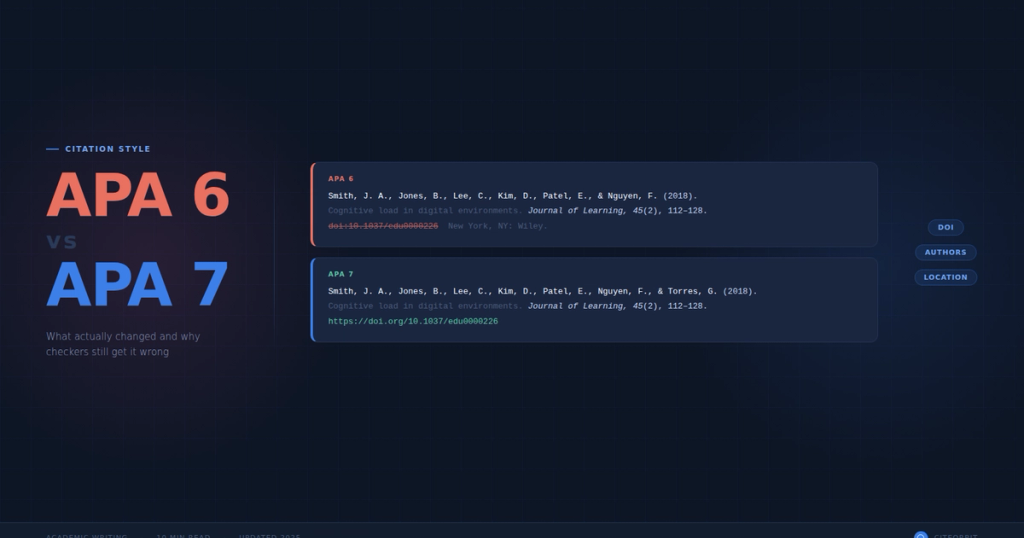
APA 7 vs APA 6: What Actually Changed and Why Checkers Still Get It Wrong
A deep dive into the real differences between editions, the logic behind the revisions, and how format-detection tools keep letting researchers down.
If you have spent any time formatting academic papers in the last few years, you have probably encountered the same frustrating moment: you run your references through an online citation checker, it comes back clean, and your professor or editor still sends them back covered in red.
The culprit, more often than not, is a citation checker that is silently applying APA 6 rules to an APA 7 document or vice versa. The two editions look similar enough that the error is invisible until someone who knows both catches it.
This guide walks through every meaningful change between APA 6th and APA 7th edition, explains the reasoning behind each shift, and examines why automated checkers so frequently fail to catch version-specific errors.
The differences between APA 6 and APA 7 are subtle enough to miss at a glance and consequential enough to matter in peer review.
Why APA Released a Seventh Edition at All
The American Psychological Association published APA 7th edition in October 2019, thirteen years after the 6th edition in 2009. The digital landscape had changed dramatically in that time: URLs had proliferated, DOIs had become standard, social media had become a citable source, and the 6th edition's handling of online sources had aged badly.
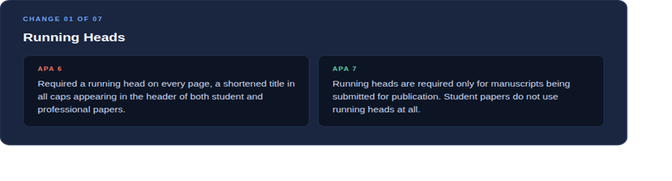
But the revision was not just cosmetic. The APA Publication Manual task force also addressed longstanding usability complaints. The running head requirement confused students, the publisher location rule created endless inconsistency, and the rigid author limit rules produced citations that misrepresented collaborative science.
The result was a 428-page manual that simplified some rules, expanded others, and created enough surface-area difference from the 6th edition to trip up anyone who learned both.
The Headline Changes, Side by Side
Here are the most significant structural changes, explained with the reasoning behind each one.
RUNNING HEADS
AUTHOR LIMITS AND "ET AL."
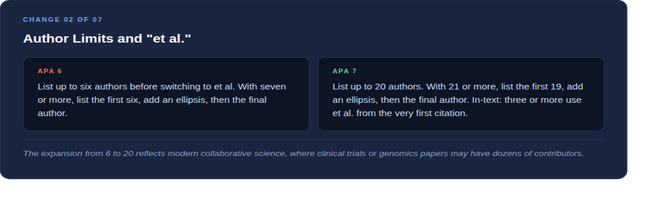
The expansion from six to twenty authors reflects modern collaborative science. A clinical trial or genomics paper may have dozens of contributors, and collapsing them all into "et al." after six authors misrepresented the actual scope of collaboration.
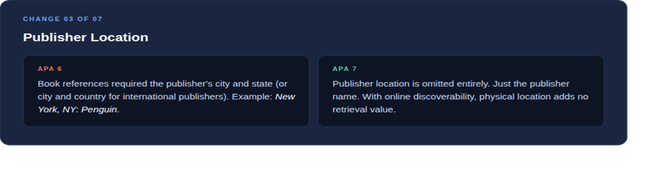
PUBLISHER LOCATION
DOI FORMATTING
WEBSITE REFERENCES
THE FULL CHANGE TABLE
Why Citation Checkers Get This Wrong
This is where things get genuinely interesting, because the failure mode is not random. Citation checkers fail in predictable patterns that reveal something about how they are built.
VERSION DETECTION IS NOT A SOLVED PROBLEM
Most citation checkers do not ask which edition you are using. They assume. And the assumption baked into most tools, particularly older ones, is APA 6, because that was the standard when the tool was built, and the update never came.
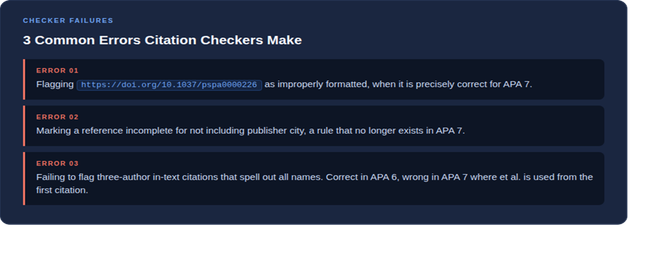
This means a DOI formatted correctly for APA 7 will be flagged as malformed by a checker expecting the legacy prefix. A reference without a publisher location, correct in APA 7, will be flagged as incomplete.
THE "ET AL." THRESHOLD CONFUSION
The in-text et al. rules changed significantly between editions, and this is where mixed-edition errors compound. A researcher trained on APA 6 writing an APA 7 paper will cite three-author sources in full on first mention. Checkers trained on APA 6 will validate this as correct, and APA 7 editors will reject it.
The inverse also happens: a checker that has partially updated to APA 7 may apply the new in-text rules but still validate the old author-list truncation at six in the reference list, producing hybrid citations that are wrong in both editions.
TRAINING DATA CONTAMINATION
For checkers that use machine learning rather than rule sets, there is an additional problem: their training data contains millions of published papers spanning both editions. The model learns a statistical average of citation styles that corresponds to no actual edition.
A citation checker that does not know which edition it is checking is not checking citations. It is recognizing citation-shaped text.
The DOI Problem in Depth
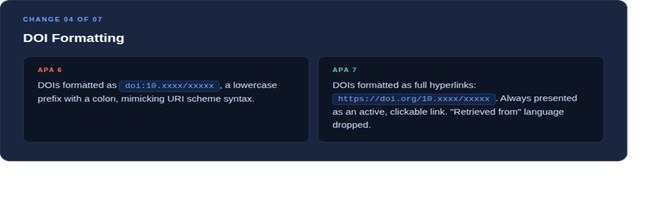
APA 6 formatted DOIs using a lowercase prefix with a colon, a format that made sense when the notation mimicked URI scheme syntax. By 2019, the DOI Foundation had established https://doi.org/ as the standard resolver prefix, and APA 7 updated accordingly.
The practical implication: in APA 7, every DOI is a working hyperlink. Not just a string that looks like an identifier, but an actual clickable URL that resolves to the source. This matters for digital-first publishing where readers encounter references on screens rather than printed pages.
Where CiteOrbit Gets It Right
If your institution or journal specifies an edition, CiteOrbit checks against that edition, not whatever default the tool was built with years ago.
Practical Guidance: How to Know Which Edition Applies
APA 7 is the current standard and should be your default for any paper written from late 2020 onward. However, some journals that were in production when APA 7 launched have not updated their style guides. If you are submitting to a journal with explicit APA 6 requirements, use APA 6 even if it feels dated.
When in doubt, look for these signals that a requirement is specifying APA 6: mentions of publisher location in book citation examples, the doi: prefix format in sample references, or instructions about running heads for student papers.
A Note on Mixed-Edition Documents
One scenario that citation checkers handle particularly badly is documents that cite sources formatted in different editions. This can happen when a researcher copies references from an older paper into a new one, or when a document includes references pulled from databases that use different default styles.
A good checker should flag edition inconsistency across the document. Most do not. They evaluate each reference in isolation, without cross-referencing whether the formatting decisions are internally consistent with a single edition.
The Bottom Line
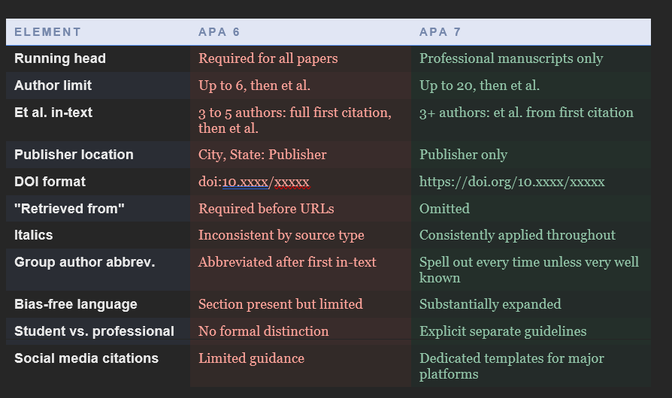
APA 7 is not a minor revision. The removal of publisher locations, the expansion of author lists to twenty, the DOI format change, the new et al. threshold, the distinction between student and professional papers: these are substantive changes that affect almost every reference type in common use.
Before you rely on any citation checker, it is worth asking a simple question: does this tool know which edition it is checking? If it cannot give you a clear answer, the output it returns may be checking the wrong standard entirely.
The APA Publication Manual 7th edition is the authoritative source for all style decisions. This article summarizes key changes for informational purposes only.